

Kauvery Hospital, Vadapalani successfully treats complex persistent fistula through innovative multidisciplinary team approach

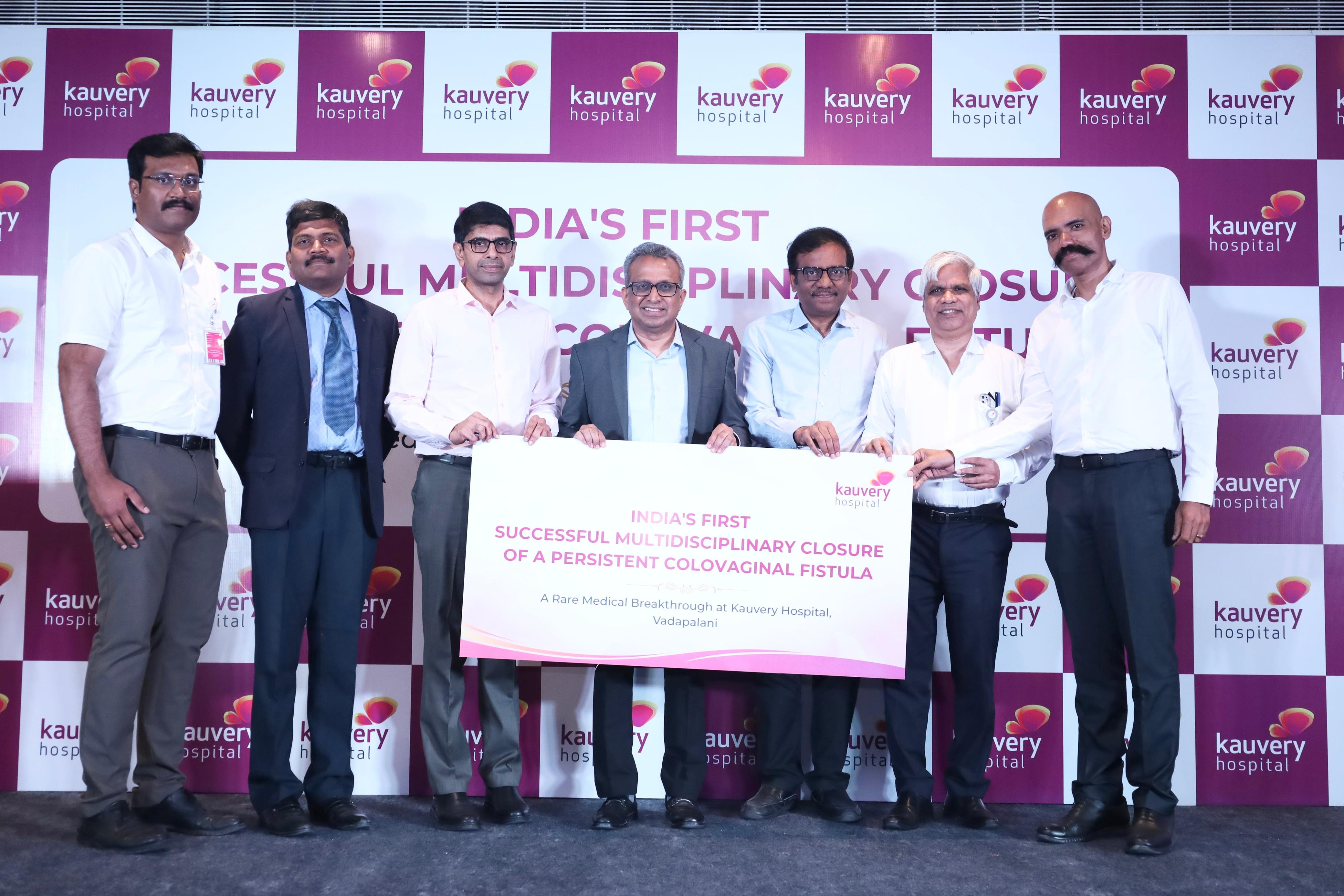
Chennai, June 04, 2026: In what is believed to be India’s first successful procedure of its kind and among the rarest interventions reported globally, doctors at Kauvery Hospital, Vadapalani successfully treated a rare and persistent colovaginal fistula, an abnormal connection between the colon and the vagina, in a 73-year-old woman using a cardiac occlusion device traditionally designed to close holes in the heart. The highly specialised minimally invasive procedure brought together the expertise of gastroenterology and interventional cardiology, offering a definitive solution to a patient with a recurrent condition that had failed to respond to multiple conventional treatments.
The patient had been suffering from persistent passage of fecal matter through the vaginal opening since 2018 due to the fistula. She also experienced recurrent urinary tract infections, continuous vaginal discomfort and irritation.
As part of her initial treatment, she underwent a colostomy – a surgical procedure in which a portion of the large intestine is diverted through an opening in the abdominal wall to allow stool to exit the body into an external bag. The affected portion of the lower large intestine too was removed. Subsequently, the patient developed a hernia at the colostomy site and underwent hernia repair surgery followed by re-anastomosis, a procedure to reconnect the previously separated sections of the intestine and restore normal bowel continuity. Despite undergoing multiple major surgeries, her symptoms persisted, and the fistula recurred.
The patient was admitted to Kauvery Hospital after multiple treatment attempts elsewhere had failed to provide a lasting resolution. One of the initial challenges was accurately identifying the fistulous tract. Extensive fibrosis, adhesions, and distortion of normal tissue planes caused by previous surgeries had made localisation of the abnormal communication extremely difficult. Through comprehensive evaluation and advanced endoscopic assessment, the gastroenterology team successfully identified fistulous communication, a critical step in planning definitive treatment.
Given the complexity of the condition and the limitations of conventional approaches for persistent fistulas, the gastroenterology team collaborated closely with the interventional cardiology team to develop an innovative treatment plan of adapting a cardiac occlusion device, typically used to close septal defects, or holes within the heart, to seal the abnormal connection between the colon and the vagina.
The approach required meticulous planning, exceptional precision, and seamless coordination between specialties, as the device had to be deployed in a completely different anatomical environment from its intended cardiac application. The procedure was successfully completed, and one week after the intervention, the patient is recovering well with significant improvement in symptoms and no immediate complications.
The multidisciplinary team was led by Dr. T.K. Anand, Senior Consultant – Medical Gastroenterologist and Interventional Endoscopist, and Prof. P. Manokar, Senior Interventional Cardiologist, Clinical Lead – Heart Failure and Transplant Program.
In his comments, Dr. T.K. Anand said, “This was an exceptionally challenging persistent fistula because multiple previous surgeries had significantly altered the anatomy. Chronic fistulas are often associated with extensive fibrosis and scarring, making accurate localisation of the tract extremely difficult. The patient had been living with this debilitating condition for several years, and our objective was not only to close the fistula but also to restore her comfort, dignity, and quality of life. Identifying the tract precisely was the key to achieving a successful outcome.”
Prof. P. Manokar, said, “Adapting a structural heart occlusion device for use outside the cardiac system is technically demanding and requires meticulous assessment of the tract, precise sizing, accurate positioning, and stable deployment. This approach highlights how innovations developed for cardiac interventions can be successfully applied to solve complex problems in other specialties when supported by multidisciplinary expertise and collaborative clinical thinking.”
Dr. Aravindan Selvaraj, Co-founder and Executive Director, Kauvery Group of Hospitals, commented, “This landmark procedure reflects Kauvery Hospital’s commitment to pushing the boundaries of patient care through innovation, collaboration, and clinical excellence. By bringing together expertise from gastroenterology, advanced endoscopy, and interventional cardiology, our teams were able to offer a life-changing solution to a patient who had exhausted conventional treatment options. Such achievements reinforce our ability to manage highly complex cases and expand treatment possibilities for patients with challenging conditions.”