

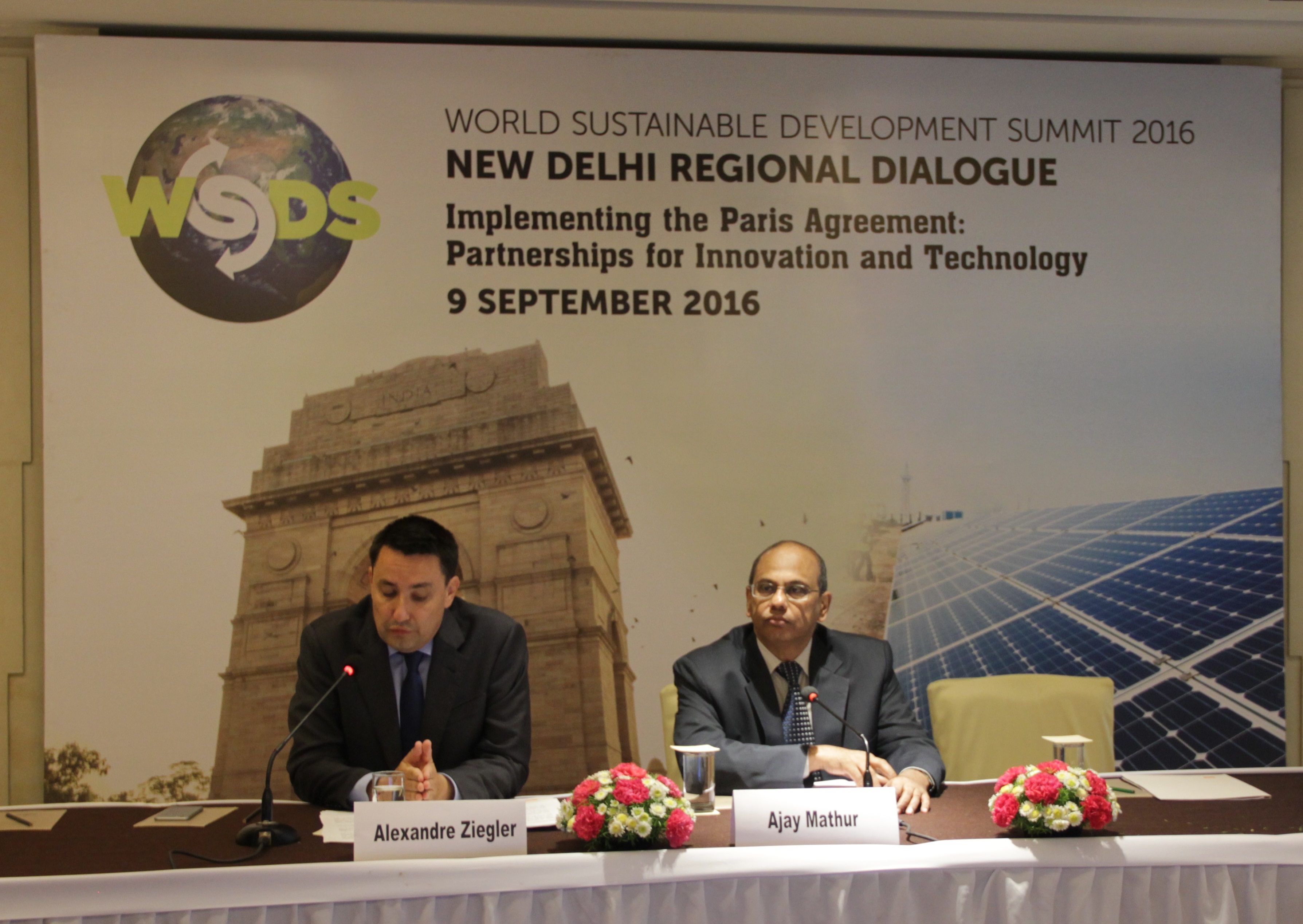
 Embassy of France and TERI discussed the challenges in achieving SDGs and presidencies of COP22
New Delhi, September 9, 2016: Citing the example of the recent Indo-French technological cooperation,H.E. Mr. Alexandre Ziegler, Ambassador of France to India said that we need to leverage our limited public resources efficiently for technology innovations that are oriented towards solutions, at the New Delhi Regional Dialogue hosted by The Energy and Resources Institute (TERI) in association with Embassy of France today.The Ambassador added that discussions on technology issues must also focus on ways to engage with the private sector as technologies are usually not owned by governments. The half-day seminar focused on partnership for innovation and technology in order to strengthen the commitment towards achieving Sustainable Development Goals (SDGs) and implementing the Paris Agreement.
Manifesting its strong will in line with the post-2015 agenda, India has already established an ambitious legal and political framework to promote sustainable development to deal with climate change. Thisis an illustration of the fact that India is committed to evaluate its development plan in the context of this environmental impact. This is an approach that is also rooted in its traditions and values of conservation and moderation, being simultaneously committed to a brighter and more sustainable future.
Emphasizingthe need for abalanced approach in achieving the SDGs,Dr. Ajay Mathur, Director General, TERI, said, “The key question is how we manage the volatility in the supply and demand of energy vis-a-vis technology change.” He added, “How people and planet will progress will depend amongst other things on how we manage technological change.” Announcing the World Sustainable Development Summit 2016, he said that ‘People, Planet and Progress’ is also the theme of the Summit which is to be held from 5-8 October.
The technological needs of the country are situated in the context of a dual economy, where, on one hand, India stands out as a growing economy with an increasingly competitive industry at the global level, a large section of the middle class, and technically qualified labourforce; and on the other hand, it faces major challenges with 70% of its population living in the rural areas, a significant numberstruggling below poverty line with low or zero level of access to electricity, health services, nutrition and drinking water. This is a situation that demandsthe requirement of a multi-pronged strategy for different segments of the economy.
Currently, there is a need to identify the gaps for facilitating the technology transfer in India. As the technology framework under the Paris Agreement remains to be designed, it would be useful to identify relevant options and requirements for technology partnerships, as well as the enablers and obstacles at the pre-commercialization, commercialization and diffusion stages.
The seminar was attended by eminent personalities such as DrPrabhatRanjan, TIFAC; Mr Cyril Carabot, Secretary General, Union for Renewable Energies, France; Prof. AmbujSagar, IIT Delhi; Prof. Jyoti Parikh, IRADe; Ms Leena Pishe Thomas, Global Business Inroads; Ms. Neelima Jain, UJALA; Dr Emmanuel Flahaut, French Commission for Atomic Energy and New Energy, France; DrAnshuBharadwaj, CSTEP Bangalore; Dr. Mukesh Kumar, CEFIPRA and Ambassador Shyam Saran, Former Foreign Secretary.
The New Delhi Regional Dialogue was the last in the series of regional dialogues across various zones that TERI hosted in the run-up to WSDS 2016– Bengaluru, Mumbai, GuwahatiandNew Delhi. The WSDS 2016 carries forward the legacy of Delhi Sustainable Development Summit (DSDS). WSDS 2016, themed ‘Beyond 2015: People, Planet & Progress’, 5-8 October, will be among the first international platforms to discuss the new development agenda post the adoption of the Sustainable Development Goals (SDG) and the signing of the Paris Agreement at the 21st Conference of Parties (COP21). The attempt will be to initiate discussions on methodologies that need to be adopted to chalk out a path to realize the SDGs beyond 2015.
ABOUT TERI
The Energy and Resources Institute is an independent, not-for-profit research institute focused on energy, environment, and sustainable development and devoted to efficient and sustainable use of natural resources. Since its inception in 1974, TERI has emerged as an institution of excellence for its path-breaking research, and is a global brand widely respected by political leaders, policy makers, corporate entities as well as the civil society at large.